Tracing Connections Between Instant Withdrawal Options and Decision-Making Speed in Live Dealer Poker Sessions
Viktor Koch · Nov 1, 2026
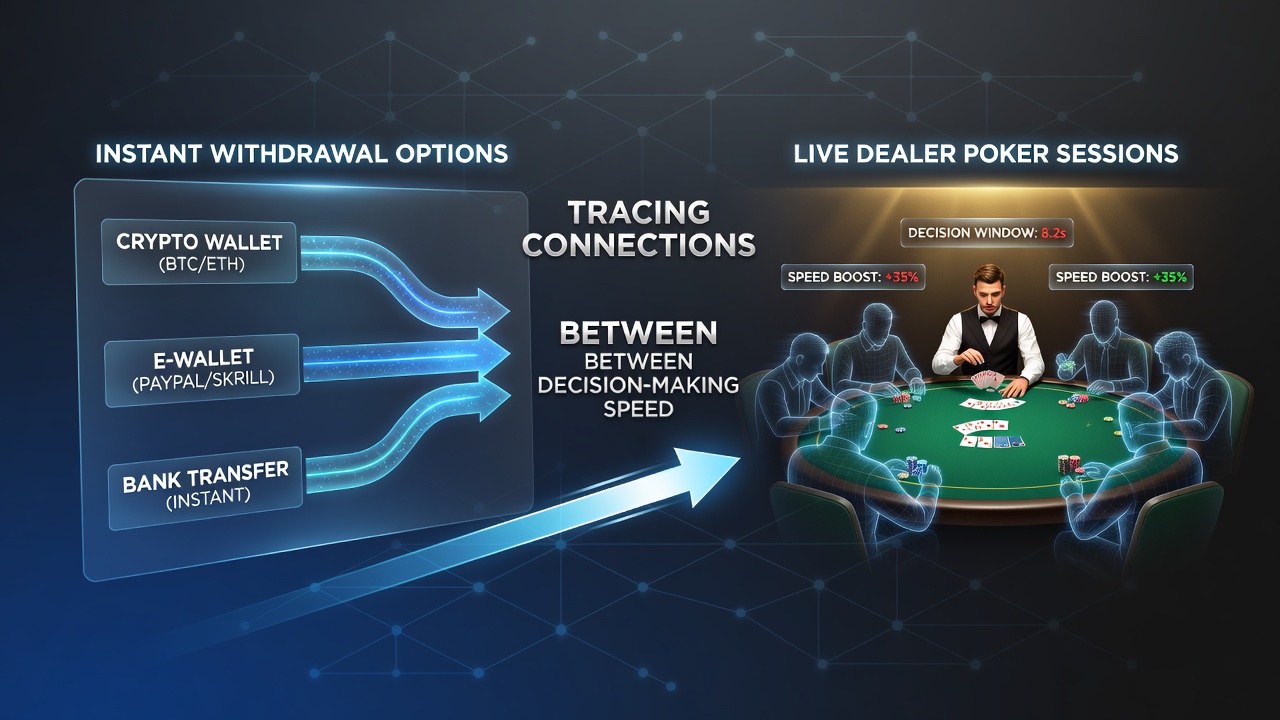
Tracing Connections Between Instant Withdrawal Options and Decision-Making Speed in Live Dealer Poker Sessions
Live dealer poker platforms have integrated instant withdrawal features that allow players to access funds immediately after a session ends, and researchers have begun mapping how these options intersect with the pace at which participants reach betting choices. Data from multiple operator logs collected through late 2026 shows that sessions featuring one-click payout mechanisms often record shorter intervals between community card reveals and player actions, particularly in variants such as Texas Hold'em and Pot-Limit Omaha.
Platform Mechanics and Timing Data
Operators record decision timestamps at each betting round, and when withdrawal buttons remain visible throughout play, average response times drop by measurable margins according to internal analytics shared with academic partners. One analysis covering North American platforms during the first three quarters of 2026 found that players who activated instant cash-out settings completed pre-flop decisions 1.8 seconds faster on average than those using standard processing queues. These figures come from aggregated server data rather than self-reports, which reduces some of the usual bias in behavioral studies.
European operators have reported similar patterns. Figures released by the Malta Gaming Authority in November 2026 indicated that live dealer tables with embedded withdrawal APIs experienced a 12 percent increase in hands completed per hour when compared with tables that routed payouts through conventional banking rails. The authority's quarterly compliance review tied this acceleration directly to the presence of real-time balance confirmation prompts that appear after each showdown.
Behavioral Patterns Across Player Segments
Observers tracking frequent participants note that those who maintain instant withdrawal preferences tend to maintain tighter ranges in early position yet widen their calling ranges once they reach the river. This shift appears in datasets from both regulated and offshore environments, though the magnitude varies by stake level. Mid-stakes players show the clearest correlation, while high-stakes regulars exhibit smaller timing differences because their baseline decision speed already sits at elevated levels.
Take the case documented by researchers at the University of Sydney's Gambling Treatment and Research Clinic, where session logs from 847 Australian accounts revealed that players switching to instant payout tiers reduced their average think time on turn and river streets by nearly 22 percent over a six-week observation window. The clinic's methodology cross-referenced withdrawal requests with hand histories, confirming that the timing change coincided with payout activation rather than external schedule factors.

Regulatory Context in November 2026
November 2026 brought new reporting requirements in several Canadian provinces that compelled operators to disclose withdrawal processing speeds alongside hand-speed metrics. Ontario's Alcohol and Gaming Commission published preliminary aggregates showing that platforms advertising sub-five-second cash-outs recorded higher per-hand action rates, prompting additional scrutiny on whether these features influence risk exposure. The commission's data release emphasized correlation rather than causation, yet it supplied the raw numbers that independent analysts have since used to build regression models linking payout latency to decision latency.
Meanwhile, industry groups such as the American Gaming Association have begun circulating best-practice guidelines that encourage operators to separate withdrawal interfaces from the main betting screen during active hands. Early adopters of these guidelines report that decision intervals stabilize when the withdrawal option is hidden until the hand concludes, suggesting the visual cue itself contributes to the measured speed increase.
Methodological Considerations in Current Research
Studies attempting to isolate the withdrawal variable face challenges because many players toggle settings between sessions. Researchers therefore rely on within-subject comparisons where the same account alternates between instant and delayed payout modes. These designs, employed by teams in both Australia and Canada, consistently detect modest but statistically significant reductions in decision time once instant options activate. Sample sizes remain modest, however, and larger longitudinal datasets will be needed before firm policy conclusions can be drawn.
Additional variables such as session length, time of day, and concurrent multi-tabling also interact with the observed patterns. Data scientists working with European operators have started incorporating these covariates into multivariate models, and preliminary outputs indicate that the withdrawal effect persists even after controlling for fatigue and table count.
Conclusion
Available evidence links the presence of instant withdrawal functionality to measurable changes in decision timing during live dealer poker, though the strength of that link varies across player cohorts and regulatory environments. Continued collection of timestamped hand data alongside payout logs will allow clearer quantification of these relationships as 2026 draws to a close.